
Timeline guide · Las Vegas valley
How long a patio cover actually takes in Las Vegas
The build is one to three days. Everything else is the schedule. Most of it is not published anywhere, so this page assembles the parts that are — and names the parts that are not.
Updated 3 August 2026 · Sources verified 2026-08-02 · Independent research, not a contractor
Installing a patio cover in the Las Vegas valley takes one to three days on site for a standard build, and up to a week or more for a custom one. The calendar time is dominated by what surrounds it: HOA architectural review, which has no deadline under Nevada law; plan review, where only unincorporated Clark County publishes a target at 14 days for a first review and 10 for each correction; and inspection scheduling.
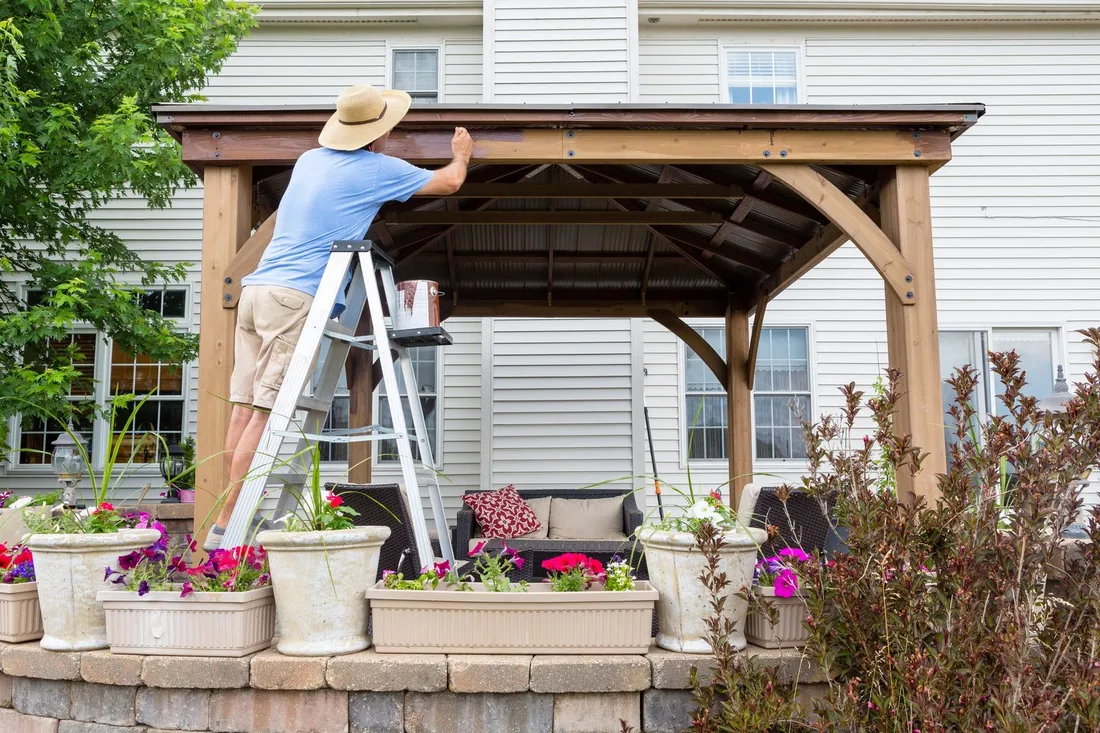
Almost every article answering this question gives you one confident number. We are not going to, because after reading what the four valley jurisdictions actually publish, one number would be a guess wearing a suit.
What follows is every component of the timeline we could source, what each one is really governed by, and an honest map of the parts nobody publishes. You will end up able to build a realistic estimate for your own project — and, more usefully, able to tell which parts of your contractor's schedule are firm and which are optimism.
The short answer, in components
| Stage | Published figure | Status |
|---|---|---|
| HOA architectural review | None in statute | No clock exists. Governing documents only |
| Engineering, if custom | Not published | Avoidable entirely with a standard design |
| Plan review, unincorporated Clark County | 14 days first review, 10 days per correction | Published, but labelled a goal |
| Plan review, Henderson / Las Vegas / North Las Vegas | None published | Genuinely unpublished by all three |
| Permit issuance after approval, Henderson | Up to 2 business days | Published |
| Material lead time | None published by any manufacturer | Vendor claims only |
| Inspection scheduling | Next day if requested before the cut-off | Cut-off published only by Henderson |
| Concrete before framing | No published waiting period | Nobody publishes this. See below |
| On site | 1–3 days standard, a week or more custom | Published, undifferentiated by material |
Read that table and the shape of the problem is obvious. The construction is the short, well-documented part. The approvals are the long, badly-documented part.
The HOA clock, and which way it runs
This is the most useful finding on the page and it is not what most people expect.
We read the two Nevada statutes that govern this — the section on association rules and the section on alterations of units — in full. Neither sets a deadline for an association to respond to an architectural application. Neither contains a deemed-approval provision. There is no point at which silence from your architectural committee becomes a yes. Nevada's 2025 legislative session did not add one; the association bills that passed dealt with solar panels, accessory dwelling units, religious and cultural items and construction hours.
What the law does require is that rules be adopted and enforced uniformly and reasonably, and that a rule not uniformly enforced may not be enforced against any owner at all. Architectural committee authority in Nevada is broad and subjective, and challenging a denial in court is, in the words of a Nevada community association manager writing about a pergola denial in a valley association last year, a difficult legal road.
Nevada law does set a deadline — on you. NRS 116.310305 requires a unit's owner to adhere to a schedule set by the association for the completion of design, the commencement of construction, the completion of construction, or the issuance of permits, and allows the association to impose and enforce a construction penalty against an owner who fails to adhere to it.
The statute then states that, for the purposes of the chapter, a construction penalty is not a fine — which means it sits outside the procedural protections the chapter attaches to fines.
So: no deadline on the association to answer you, and a penalty available against you for missing theirs. Start the HOA application first, keep a dated copy of what you submitted, and follow up in writing.
One practical consequence worth naming. Because no statute sets the clock, whatever your governing documents say is the clock — which is why an internal contradiction in those documents actually matters. One major valley association's guidelines state a 30-day review while its own request form says 30 business days. There is no statutory backstop to fall back on when the two disagree. Get the answer in writing before you submit.
One to recheck. The Nevada legislature has published two versions of the association rules section — one effective through 30 June 2026 and one effective 1 July 2026. We could not retrieve the text of the newer version. Given today's date the amended version is already in force and its content is unknown to us. Confirm the current text before relying on this section.
Plan review, jurisdiction by jurisdiction
Only one of the four publishes anything, and it is careful about what it is promising.
| Jurisdiction | First review | Corrections |
|---|---|---|
| Unincorporated Clark County | 14 days — residential minor | 10 days |
| City of Henderson | Not published | Not published |
| City of Las Vegas | Not published | Not published |
| City of North Las Vegas | Not published | Not published |
Clark County's table is headed "First Review Timeframe Goals." The word is goals, not deadlines and not guarantees. And — this matters more than it sounds — the page does not state whether those are business days or calendar days. Fourteen business days is very nearly three calendar weeks; fourteen calendar days is two. We checked twice and the qualifier is simply absent, so we will not convert it for you.
Note also that the correction figure is the one that decides your schedule. A single correction cycle adds its own review on top of the first, and a project that goes around twice has spent more calendar time in correction than in first review.
Permit expediting companies publish turnaround figures for the three jurisdictions that do not — one attributes 25 to 50 days for a first review and 20 to 30 days for a resubmittal to North Las Vegas, citing the department as its source. We could not find those numbers in any department publication.
We are not saying they are wrong. Expediters file permits for a living and their figures may well reflect reality better than a published goal does. We are saying they are unverifiable, and they are two to three times the only officially published figures in the valley. Treat them as somebody's experience, not as policy.
The four-day week nobody mentions
Two of the four valley permit counters do not work Fridays, and the knock-on effect is a real, sourced schedule cost.
- Henderson permits and plan check run Monday through Thursday. Items received after 4:30pm are not processed the same day, and online applications submitted after hours on Thursday, or any time Friday through Sunday, are processed as though they arrived on the next working day. Submitting at 5pm on a Thursday costs three calendar days before anyone opens the file.
- North Las Vegas development services runs Monday through Thursday as well.
- Henderson inspections, by contrast, run Monday through Friday, 6am to 4pm. Same department, different week. Worth knowing when you are planning the back end of the job.
Henderson also rejects — rather than corrects — a resubmittal that arrives without a written narrative describing what changed. That is the difference between a correction cycle and a wasted one. The Henderson permit walkthrough covers the submittal rules in full.
Inspections: the sequence and the scheduling
The sequence is set by the code, not by your contractor
Two provisions of the residential code do most of the work here, and both have consequences people are surprised by.
The foundation inspection happens before the pour. The code says the foundation inspection is made after trenches are excavated, forms erected and reinforcing steel is in place and supported — prior to the placing of concrete. It is not an inspection of a finished footing. If it is missed or fails, the pour does not happen, and if the pour already happened, something gets opened up.
The framing inspection cannot pass until the electrical rough has passed. The code says framing inspection is made after the roof, framing, firestopping, draftstopping and bracing are in place and after the plumbing, mechanical and electrical rough inspections are approved. So if your cover has lights or fans, the order is fixed:
- Footing or post-hole inspection — before concrete
- Electrical rough — if the cover has any electrical
- Frame
- Final
That is at least three and usually four separate inspector visits, each of which is a scheduling event. It is the single biggest reason a two-day build spans two or three weeks.
This sequence comes from the model residential code language. We could not retrieve Clark County's own required-inspections code section — its code portal renders client-side, its mirror blocked us, and the county's own administrative code PDFs truncated before the section. The valley jurisdictions adopt this code, but local amendments to the inspection sections are unverified. Henderson prints the inspections your specific permit needs on page three of the issued permit, in scheduling order — read that before you book anything.
Scheduling, and what it costs to jump the queue
| Jurisdiction | How far ahead | Cut-off | Paid options |
|---|---|---|---|
| Unincorporated Clark County | Immediately after issuance; online and automated phone 24/7, up to five days ahead | Weekday cut-off not published. Saturday requests by 2pm Friday | $105 re-inspection penalty |
| City of Henderson | Up to five days ahead, through the online portal | 4pm for next day; inspections 6am–4pm Mon–Fri | After-hours by request form |
| City of Las Vegas | Online scheduling | Not published | Express $186 per hour; callout $421 |
| City of North Las Vegas | Self-service portal. Patio covers are named as eligible for remote video inspection | Not published | Same day $100; weekend $400 |
Three things in that table are worth pulling out.
- Only Henderson publishes a weekday cut-off. The other three publish scheduling channels and, in two cases, detailed prices for buying a faster slot — but not the time by which a free next-day request has to be in. The City of Las Vegas publishes what it costs to jump the queue in considerable detail and never says how long the queue is.
- North Las Vegas names patio covers as video-inspection eligible, which can remove a scheduling round trip entirely. Henderson's virtual inspection programme, by contrast, covers only water heater and HVAC replacements and states plainly that no other types qualify.
- A failed inspection in Clark County carries a $105 penalty that must be paid before anything further can be scheduled. Charged on a 'disapproved with penalty' result, and payable before any further inspection can be scheduled. That is a schedule risk as much as a cost one.
One more useful Clark County figure: permits there expire 180 days from issuance or from the last approved inspection. Each passed inspection restarts that clock, which matters if your project stalls between stages.
Concrete, and what the heat actually does
If your cover needs footings or a new slab, concrete enters the schedule. This is the part of the timeline where the local climate stops being colour and starts being a constraint.
The relevant industry specifications limit the maximum temperature of the concrete itself to 95 °F at the time of discharge. Above that, the mixture has to be supported by successful past field experience or by preconstruction testing submitted to the engineer before placement. In a valley whose mean July high is 104.5 °F, keeping the concrete under 95 °F is a real operational task — chilled water, ice, shading the aggregate, or pouring early.
The hot weather concreting guide is careful not to define hot weather by a single air temperature. It defines it as a combination of conditions: high ambient temperature, high concrete temperature, low relative humidity and high wind speed. Its own example is that precautions required on a windy, sunny day will be stricter than on a calm, humid day at the identical air temperature. The Las Vegas valley in summer hits all four of those conditions at once, which is a stronger statement than any threshold would have been.
The consequence is not that concrete cannot be placed here in July. It is that placing it well takes measures, and that concrete cured hot gains early strength quickly but ends up weaker at later ages than the same concrete cured at moderate temperature. The industry guidance is straightforward: avoid the hottest part of the day.
We went looking specifically for a published waiting period between pouring a patio cover footing and framing on top of it. We checked the concrete institute, the ready-mixed concrete association, the cement association and the federal highway administration. No authoritative source publishes one, and no valley jurisdiction requires one that we could find.
The three-to-seven days you will see quoted is a curing recommendation — how long to keep the concrete moist and protected — and that is a different question from when it can carry load. The structural criterion is strength, and design strength is specified at 28 days. Do not let anyone convert one into the other without saying so, in either direction.
Days on site
A cost guide with a stated methodology puts professional patio cover installation at one to three days, with custom projects running to a week or more. The same guide notes, correctly, that permits add to the timeline because inspections are needed before, during and after construction.
For motorised louvered systems the only figures published are vendors' own: one manufacturer says approximately two days per zone, and a dealer in another region describes the frame going up in one to two days with three to five days of overall site activity. Those are marketing documents, and we label them as such.
What no source does is break the on-site duration out by material. Nobody publishes aluminium versus site-built wood versus louvered. We are not going to invent that breakdown, though the intuitive ordering — a pre-engineered aluminium kit goes up faster than a site-built wood structure — is what you would expect and what contractors will tell you.
Material lead times: essentially unpublished
We searched the manufacturers and distributors of aluminium patio cover systems and insulated panels for a published production or shipping lead time. We found none. Not one.
The most instructive result was a refusal. The largest motorised louvered pergola brand in the country states, in its own installation guide, that because every pergola is custom ordered, lead times vary depending on location, freight schedules, job complexity and the dealer's installation calendar — and gives no number at all.
That is worth taking seriously as a consumer signal. When the manufacturer will not commit to a lead time in writing, the date your contractor quotes comes from their own calendar rather than from the factory's. Ask what it is based on, and ask what happens to your schedule if it slips.
Season, heat rules and start times
Seasonality
No source publishes a busy season for patio cover installation in the Southwest. Federal employment data for all specialty trade contractors in the Las Vegas metro does show a consistent annual pattern — a trough through December to February and a peak from late spring into early autumn, with a peak-to-trough swing of roughly six percent. That is every trade in the metro rather than this one, so it supports a general statement about when the valley's trades are busiest and nothing more specific.
Nevada's heat rule does not shorten the workday
Nevada adopted a heat illness prevention regulation that took effect in November 2024, with enforcement commencing 29 April 2025. It applies to employers above a small-employer threshold, defines a heat priority day as any day where the temperature reaches or exceeds 90 °F, and requires a written programme including rest breaks for employees showing signs of heat illness and a one-time written job hazard analysis per task.
What it does not do — and the state's own guidance says so explicitly — is specify mandatory work-hour restrictions or time-off requirements. It is a programme-and-protection rule, not a curfew. It should not, by itself, move your schedule.
One detail worth flagging because it decides coverage for a small crew: the state's guidance describes the rule as applying to employers with more than ten employees, while at least one legal summary describes it as ten or more. For a two-truck patio cover contractor that is exactly the line. We are flagging the discrepancy rather than picking one.
The 5 a.m. start almost certainly does not apply to you
Nevada's 2025 legislature allowed construction work to begin at 5 a.m. between April 1 and September 30 — but only on projects more than 300 feet from an occupied residential unit, and the statute overrides association governing documents to that same extent.
A patio cover attaches to an occupied house. It is not 300 feet from one. So the summer early start does not reach a backyard patio cover job, and the crew cannot lawfully beat the heat that way under this statute. The ordinary residential baseline — a 7 a.m. start — applies.
We could not retrieve Clark County's construction-hours ordinance itself. The 7 a.m. to 6 p.m. baseline comes from press reporting on the predecessor law, while the county's code enforcement page says it responds to construction noise complaints between 10 p.m. and 6 a.m. Those two windows are not reconcilable from what we could read, and we are not going to merge them into one figure. If working hours matter to you, ask the county directly.
Assembling your own estimate
Rather than a single number, here is the honest arithmetic. Add up the stages that apply to you, and mark clearly which ones are published targets and which are somebody's estimate:
- HOA review — whatever your governing documents say, with no statutory backstop. Start it first. This is usually the longest single stage and the least predictable.
- Engineering — zero if you build to a standard design or an approved system, some unknown number of weeks if you go site specific. This is the stage most under your control.
- Plan review — 14 days as a goal in unincorporated Clark County; unpublished everywhere else. Add 10 days per correction cycle in the county, and assume at least one cycle unless your submittal is unusually clean.
- Issuance — up to two business days after approval in Henderson; unpublished elsewhere.
- Materials — unpublished by every manufacturer. Get your contractor's number in writing and ask what it is based on.
- Build and inspections — one to three days of work, spread across three or four inspection visits with scheduling between each.
The two levers that genuinely move this are choosing a standard design over a custom one, and starting the HOA application before anything else. Both are free. Our jurisdiction permit guide covers which standard designs each city accepts, and the cost guide covers what the custom route adds in money as well as time.
What isn't published
Collected in one place, because it is a long list and it is the point:
- Whether Clark County's 14-day and 10-day goals are business days or calendar days.
- Any plan review or resubmittal turnaround for Henderson, the City of Las Vegas or North Las Vegas.
- Weekday inspection request cut-off times for Clark County, the City of Las Vegas and North Las Vegas. Only Henderson publishes one.
- Clark County's own required-inspections code section, which we could not retrieve. The sequence on this page comes from the model code language.
- Any waiting period between placing concrete and framing on it, from any authoritative body or any valley jurisdiction.
- Manufacturer lead times for aluminium patio cover systems or insulated panels. None published, anywhere.
- On-site duration broken out by construction type.
- A busy season for this specific trade in the Southwest.
- Clark County's construction hours ordinance, and the reconciliation of the two different windows described above.
- The current text of the Nevada association rules statute as amended effective 1 July 2026.
Common questions
How long does patio cover installation take in Las Vegas?
How long does a patio cover permit take in Las Vegas?
How long does an HOA have to approve a patio cover in Nevada?
How long does concrete need to cure before a patio cover can be framed?
Can a crew start at 5 a.m. in summer to beat the heat?
Is there a busy season for patio covers in Las Vegas?
Sources
- Clark County — plan review timelines — Headed 'First Review Timeframe Goals'. Residential minor 14 days; corrections and all subsequent reviews 10 days. Day type not stated.
- Clark County — inspections FAQ and scheduling — Scheduling channels, the five-day forward window, the Saturday cut-off, the re-inspection penalty, and the 180-day permit expiry.
- City of Henderson — building inspections and building permits — 4pm next-day cut-off, 6am–4pm Monday to Friday inspections, the 4:30pm processing rule and the Monday–Thursday permit week.
- City of Las Vegas — express and overtime inspections fee schedule — Express, special, overtime and callout rates. The city publishes what it costs to jump the queue but not how long the queue is.
- City of North Las Vegas — permit application center and remote video inspection program — Patio covers named as video-inspection eligible; same-day and weekend inspection fees.
- Model residential code, section R109.1 — required inspections — Verbatim reproduction by a jurisdiction that adopted it. Source for the pre-pour foundation inspection and for framing following the electrical rough. Clark County's own amended section could not be retrieved.
- American Concrete Institute — maximum concrete temperature at discharge, and ACI 305R-20 Guide to Hot Weather Concreting — The 95 °F discharge limit, and the definition of hot weather by combined conditions rather than by an air temperature threshold.
- National Ready Mixed Concrete Association — CIP 11 Curing In-Place Concrete and CIP 12 Hot Weather Concreting — The three-to-seven-day curing recommendation, and the guidance to avoid placing in the hottest part of the day. Note this is curing, not a framing wait.
- Nevada Revised Statutes chapter 116 — common-interest ownership — Sections 116.2111, 116.31065 and 116.310305 read in full. No association response deadline; construction penalties available against the owner and expressly not fines.
- Nevada Division of Industrial Relations — heat illness prevention guidance for regulation R131-24AP — Enforcement from 29 April 2025; heat priority day at 90 °F; and the explicit statement that the regulation does not specify mandatory work-hour restrictions.
- Nevada Legislature — Assembly Bill 478, 83rd session (2025), construction start hours — The 5 a.m. April-to-September start applies only more than 300 feet from an occupied residential unit.
- US Bureau of Labor Statistics — specialty trade contractor employment, Las Vegas metro, not seasonally adjusted — Source for the seasonality pattern. All specialty trades in the metro, not patio cover installers specifically.
- Angi — patio cover installation cost guide — Updated 2026-05-30. Source for the one-to-three-day standard installation and the week-or-more custom figure.
Las Vegas Patio Cover Guide is an independent research and referral service. We are not a licensed contractor, we do not perform construction work, and we do not sell patio covers. When you send a request through this site we pass it to an independent local contractor who is licensed to do the work. Any quote, contract, warranty and workmanship is between you and that contractor. Always verify a contractor's licence, status and monetary limit yourself at nvcontractorsboard.com before signing anything or paying a deposit.
Get a schedule you can actually check
Tell us the size and the jurisdiction and we will pass it to independent contractors working there. When the schedule comes back, ask which stages are their estimate and which are the city's — this page gives you everything you need to tell the difference.